
I’m sitting on a white, textured arm chair, teasingly deemed ‘my throne,’ when we begin.
It’s Saturday evening, and there are six of us gathered around a rectangular, wooden coffee table, all sat upon mismatched furniture. One green, one brown couch. One gingham and one orange arm chair. One swiveling white accent chair at the head of the table.
In front of us, a fictional map of a place called the ‘Sword Coast’ lays flat on the coffee table, quadrants still creased from being folded. Empty character sheets, cracked open guide books, scrap paper, pens and highlighters, dice, and even faux flickering candles clutter the outskirts of this unexplored realm.
“Are we all ready?“
Five pairs of eyes flick up.
Until two weeks ago, the storytelling, role-play game Dungeons & Dragons (D&D) existed as an abstract concept in my mind. Sure, I’ve known a handful of people who played the table-top game, and yes, I’ve seen highlight clips of talented voice actors, comedy writers, and internet personalities improvising their way through scenes. But I certainly wouldn’t have said I knew much about the game.
And, even though the idea of crafting a story for your friends and playing through it together was incredibly intriguing to me, I’d been storing D&D deep in my grey matter with a ‘FOR LATER’ label slapped on it. Mainly because learning about the rules, story structure, character types, monsters, lore, and even the different types of dice seemed like too large of a hurdle to hop. Merely a mental approach of that dusty shelf would surface more questions than I knew what to do with – and again, up until two weeks ago, the overwhelm of it all had been enough of an obstacle to stop me from trying.
So, what changed?
I’m turning 28 this year and, as silly as it might sound, I’m beginning to realize that this apprehension of not being completely perfect at something on the very first try shouldn’t get to stand in the way of me having fun. I think it’s something a lot of young adults struggle with, a kind of perfectionist paralysis. Or, perhaps it’s a fear of being ‘cringe’ that keeps us stuck.
But, what if we embraced the side of us that’s yearning to put our creativity and curiosity to use?
What if we made joy a priority in our life, like it was back in childhood?
These are the guiding questions behind why I’ve invited five friends to join me on my bumbling journey to get a handle of D&D, but also why I’ve started this blog in the first place.
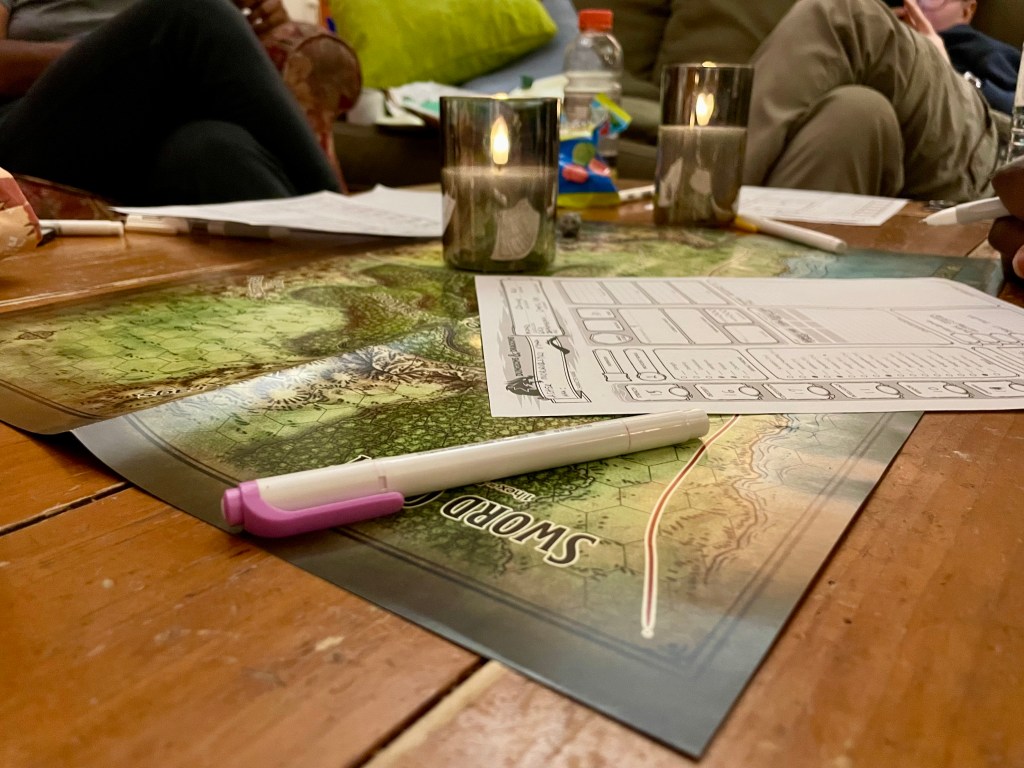
Now, here I am, sitting at the head of this water-stained, scratched-up coffee table, feeling deeply unprepared, but trying to be okay with it.
Designated as the Dungeon Master (DM)- or the game’s lead storyteller and referee, as the D&D website put it – I am supposed to guide us through a story that came inside a kit. The week leading up to this point, I’d been reading through the DM’s-eyes-only story book, trying to get a feel for the plot and the many predetermined quests my adventurers could take. I’d flipped through the game’s rule book, too, nodding along as I went, thinking I had a basic understanding of the character building process – the very first step in starting a campaign, and what we’re planning on doing during this very first session.
However, as I’m reading the starting town’s description to the five adventurers – only one of whom has played D&D before – I’m beginning to realize this is actually a lot more complicated than I’d initially thought. The reading itself is no problem, it’s more so the retaining of that information afterward that’s the tricky bit. Particularly because the adventurers also have questions about the town! Questions that I don’t have answers for until I glance back down at the book to re-read.
It kind of feels like taking an open-book quiz.
It’s fine, though. It’s fine to re-read passages from the story book, I tell myself.
Balancing our paper plates of pizza and pointing at the marked locations on the map, we talk it out until we’re all on the same page – and, for the record, nobody gets impatient, nobody rolls their eyes, and nobody accuses me of doing a bad job.
Then, we’re building our characters, and everybody except the friend who has played D&D is confused because there’s definitely a lot to it. I thank the heavens, and M, himself, repeatedly, that he’s here to answer all 62 of our questions.
First, we choose our character’s race, which gives them certain traits, capabilities, and advantages.
There are nine races to choose from in M’s D&D Players Handbook (2014), including dwarves, elves, halflings, humans, dragonborn, gnomes, half-elves, half-orcs, and tieflings. I flip through my essentials kit handbook and M flips through his triple-the-size, gorgeous hardcover handbook, both of us reading and summarizing the basics of each race to the rest of the adventurers.
M knows most of it off the top of his head, and I remember a handful of things without reading them directly off a page. And, almost magically, the embarrassment I’d been anticipating about not having the answer to everything doesn’t come.
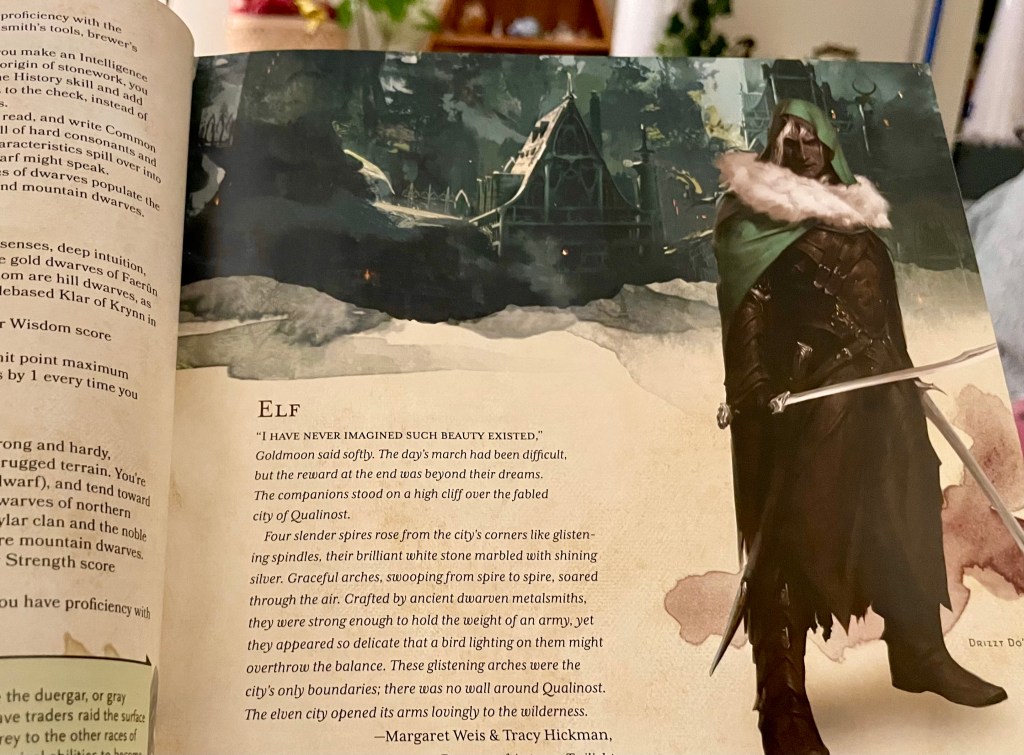
From there, we choose our character’s class, which is representative of their calling. “Class shapes the way you think about the world and interact with it and your relationship with other people and powers in the multiverse,” the handbook reads.
And there are 12 classes to choose from: barbarian, bard, cleric, druid, fighter, monk, paladin, ranger, rogue, sorcerer, warlock, and wizard – each of them also giving your character special features.
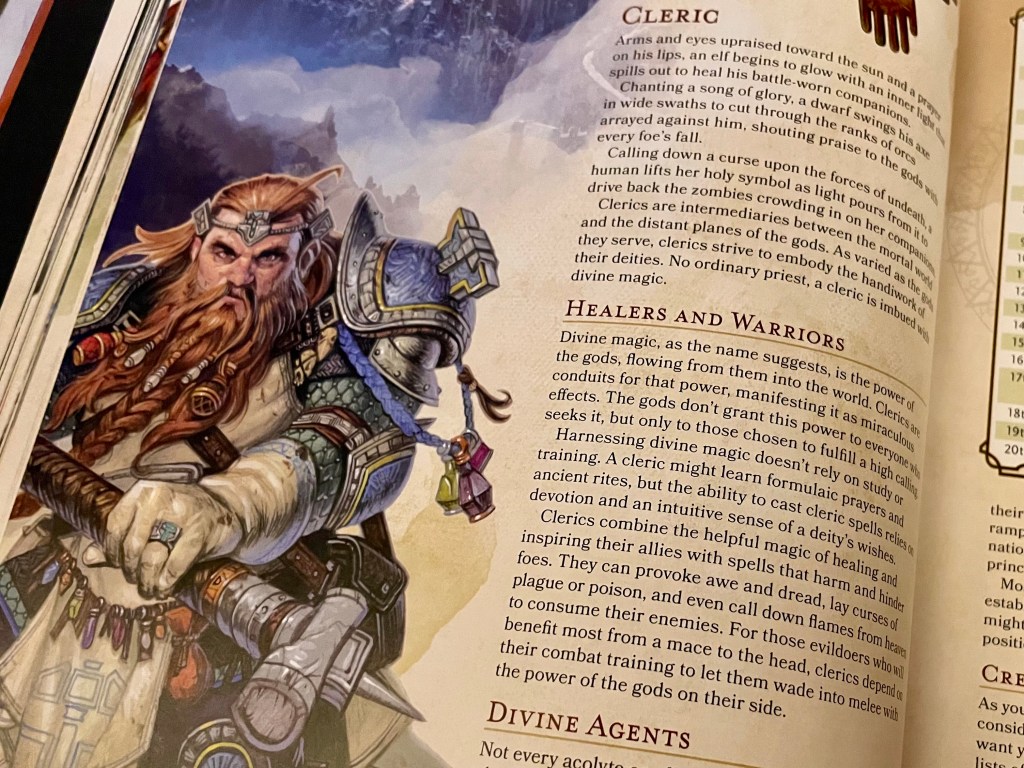
(Clerics are spell-casting healers, with their divine powers given to them from the gods)
There’s a lot of layering going on when you’re building a character, and these are technically only the first two layers, but they’re very influential over who your character is in the world.
As we flip through M’s handbook, we look at illustrations of half-orcs with boar-like tusks peeking out of the corners of their mouths, of elves with their willowy, elegant bodies and long pointed ears, of halflings with their compact little bodies and brightly coloured outfits. The pages are rich with lore, abilities, and personality traits, and the urge to read the entire handbook, all 300 pages of it, right then and there strikes me. It’s a whole new world to learn about.
I won’t get into all of the details of character building. Partially because we had so many questions for M that we ran out of time and didn’t finish building our characters, and partially because I’m still a bit confused about it all. But that’s okay! It’s okay to be confused, it’s okay to have lots of questions, and it’s okay if things move a little slower because of that.
Five out of six of us have never played D&D before, so we can’t expect to speed right along into the story, and we can’t expect to immediately know how to build characters without having done so before.
We wrap up the evening about two hours later, our bellies full of pizza and most of our heads whirling with numbers and terms that reflect our characters’ skills, equipment, armor, and much more. I feel similarly to when I’ve finished the first lecture of a course I’ve been waiting to take. Wrist tired from scribbling down notes, head rushing with new information, but most notably, a quiet simmering of pride behind my ribs. A feeling of accomplishment, even though it’s only the beginning of the road.
The next morning, this reel from @juliansew on Instagram was dropped into the group chat.
 Dani Penaloza
Leave a comment